Every year, icy contact wires pose problems for transport companies. There are methods for de-icing, but many users want better solutions. Thanks to the new product GLEITMO RAIL PL from FUCHS and an ingeniously simple idea from a Dresden-based inventor, these solutions are now available.
It's a winter morning, just before six. It's cold at the bus stop, and visible clouds of breath hang in the air. The display announces a delay – the cause: icy overhead lines. This is a familiar winter scenario for many passengers. However, ice on overhead lines is more than just a nuisance; it can become a serious problem for transport companies: electricity “jumps” across the insulating layer of ice, creating a spark or electric arc while the train is moving. Excessively strong electric arcs can cause pieces of carbon to burst out of the contact strip, which then fall to the ground glowing red-hot. When this happens, the contact strip has to be replaced.
Ice on overhead lines is a common problem in winter. It often forms overnight, especially during freeze-thaw cycles. To prevent this, rail operators rely on de-icing agents. “However, traditional methods are not very effective,” explains Ralf
Schlösser. He is a trained railway engineer and Business Development Manager Railway at FUCHS. Schlösser's job includes keeping an eye out for new trends and checking whether FUCHS is correctly positioned in the market.
CHALLENGE ACCEPTED
To tackle this, Schlösser talks frequently with railway operators. "At a trade fair, a visitor asked me whether FUCHS offers a product for de-icing overhead lines," he recalls. “They were dissatisfied with the product they had been using.” At that time, no such product existed. However, FUCHS is committed to offering complete solutions for rail transport. “We accepted this as a challenge,” says Schlösser.
Research and development are a high priority at FUCHS, with around ten percent of the workforce employed in this area. And so Schlösser's colleagues set about developing a solution. "The products on the market that we looked at were problematic for the environment, caused corrosion on the contact wire, or performed poorly," explains Dr. Maximilian Weber. He is a chemist at FUCHS and develops lubricating greases.

“Traditional methods for de-icing overhead lines are not very effective.“
GREASE INSTEAD OF SLIP COATING
Initially, FUCHS conducted research in the field of lubricating varnishes in order to find a de-icing agent. Then the developers realized that the finished product needed to have different properties. “Glycerin is widely used as a de-icing agent,” explains Weber. "It removes ice, but does not have a preventive effect." FUCHS therefore sought a substance that would adhere to the contact wire and prevent new ice formation. This led to the project focusing on lubricating greases and Weber, who worked with his team to develop a solution that FUCHS now offers as a product.
"With GLEITMO RAIL PL, we have a transparent, odorless, non-flammable, water-based anti-ice fluid," says Weber. It is biodegradable and environmentally friendly. Its flow behavior is pseudoplastic, which means that it is more fluid when in motion and becomes more solid when at rest. This allows it to form a durable film on the contact wire, providing long-term protection against ice. The agent can be sprayed, rolled on, or applied manually. This leads to another challenge, because even the common methods of applying deicing agents are not satisfactory.
"Our anti-icing fluid is transparent, odorless, and biodegradable."
PROBLEMS WITH THE FELT ROLLER
Every year, Dresden's public transport company also has to contend with ice on the wires of its trams. A rotating felt roller has long been used for this purpose. "The system is high-maintenance, often malfunctions, and the extremely fast-rotating mass on the protruding pantograph arm is simply difficult to control," explains Maximilian Simchen. He is the engineer responsible for special vehicles at Dresden's tram company and thus also for de-icing the overhead lines. "When contact wires cross, the device must be lowered beforehand, otherwise it can get stuck and, in the worst case, the entire bracket with the device can break off," explains Simchen.
He is a passionate tinkerer; even as a child, he motorized bicycles and built a Stirling engine from household materials. After school, he studied mechanical engineering at the Technical University of Dresden, specializing in rail vehicles. The process of de-icing contact wires sparked his curiosity. "Another system works with spray nozzles and optical sensors,“ explains Simchen. ”With this system, a large part of the agent doesn't even end up on the wire." In addition, the system is complicated and prone to malfunction.

"When it comes to de-icing, it's not just the equipment that needs to be robust, but the entire process."
MACHINE DESIGN PRIMITIVE IN THE BEST SENSE OF THE WORD
What the inventor then comes up with is not complicated at all. Weber calls it “elegant,” Schlösser finds it “ingenious.” Simchen describes it as “primitive” – and means that it is simple and robust in the best sense of the word.
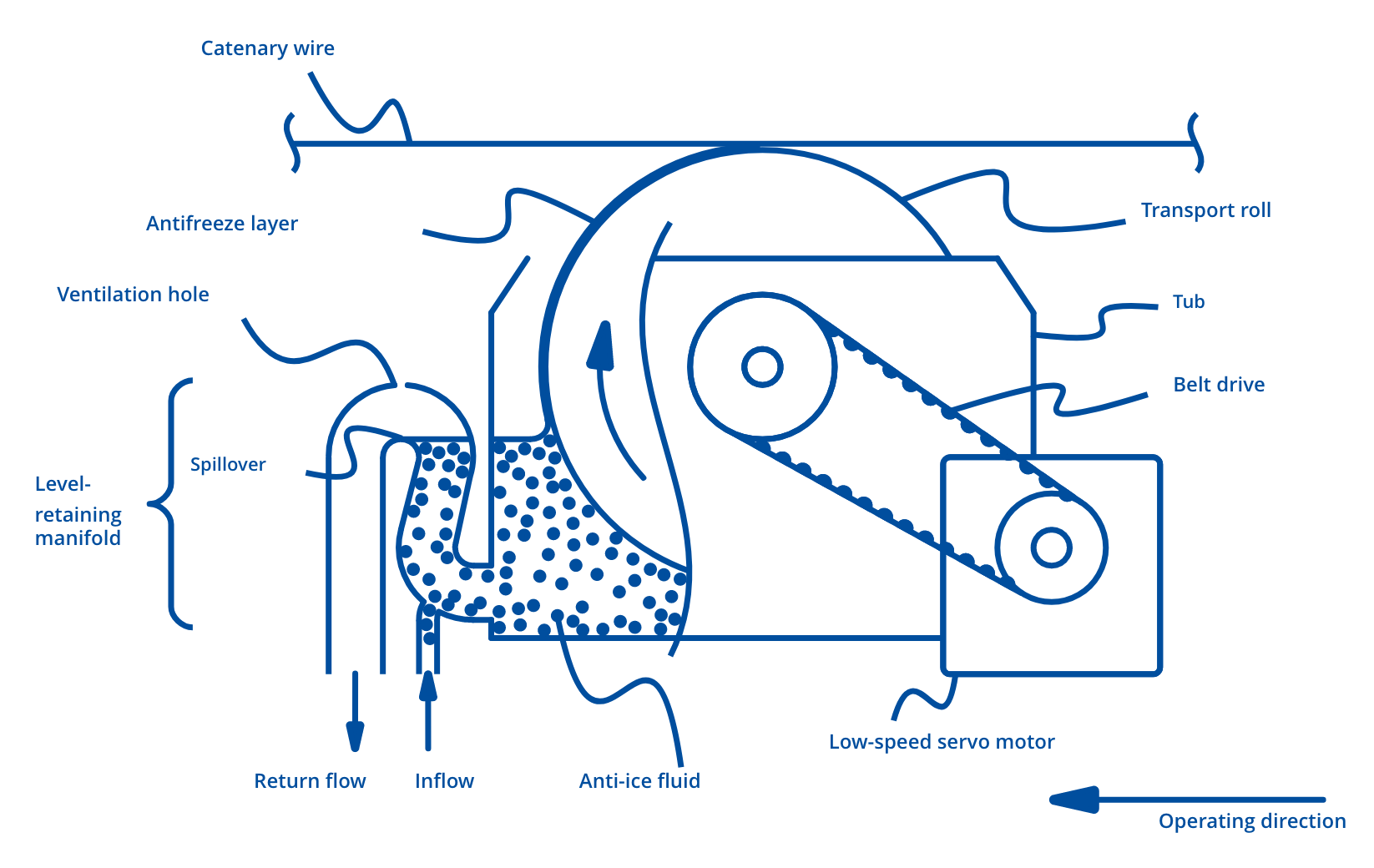
His “contact wire lubricator” uses a roll-gliding method developed by Simchen: instead of rolling up a liquid as with the felt roller, the special roller coats the contact wire. Without any fast-moving components or sensitive sensors, the application device is mounted on a pantograph frame. The shape of the roller corresponds to that of the collector's contact strip. “This allows the device to pass over all crossings without any problems,” says Simchen. "In addition, unlike the felt roller, it hardly deflects the contact wire at all, because even with very low contact forces of around 1 kilogram, it works completely normally."
The contact wire lubricator in action: The video shows Simchen's invention being tested.
DEVELOPMENTS COMPLEMENT EACH OTHER PERFECTLY
During a visit to DVB, Schlösser meets Simchen and his device – and is immediately impressed. Schlösser introduces Weber to Simchen, and a very pragmatic exchange quickly develops between the two. The chemist and the mechanical engineer speak the same language when it comes to functionality and suitability for everyday use. While Weber continues to develop the fluid, Simchen tests its practical applicability. Both see great potential in the joint application of their respective inventions.
“Not only does the device have to be robust, but the entire process,” explains Simchen. It must work under different conditions and with a variety of liquids. Then the applicator becomes a minor issue: "Developers can focus on the essentials: on the performance of the liquid on the contact wire," says Simchen. This is an incentive for Weber, who is already looking forward to testing new deicing agents with the lubricator.
How the contact wire lubricator works
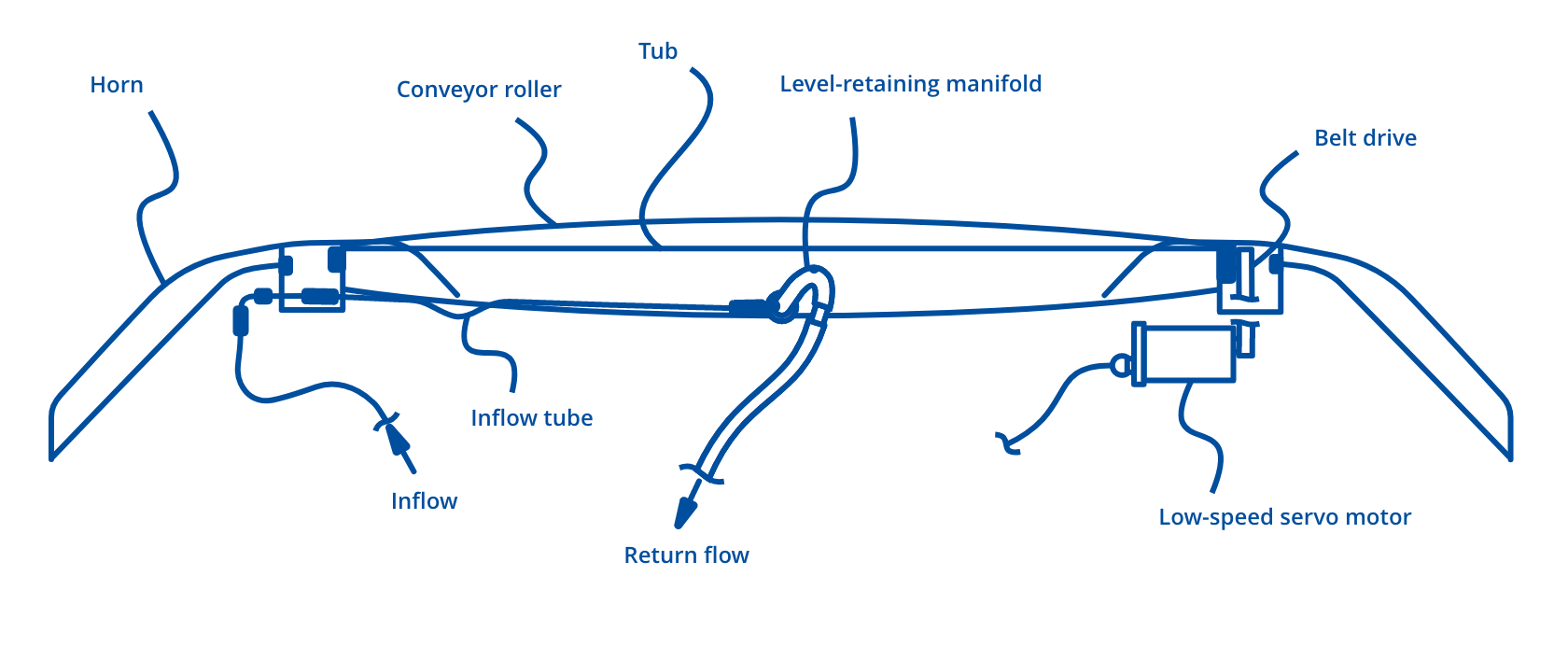
At the heart of the device is a transfer roller made of a special friction-optimized material. The underside dips into a tray filled with antifreeze, and a servomotor rotates the roller slowly and continuously. The top side receives just enough antifreeze and spreads it onto the pipe. Read more about the contact wire lubricator!
More about the roll-gliding method and the contact wire lubricator.
NEXT STOP: SMALL SERIES
Simchen has obtained a patent for his device and the roll-gliding method and, in addition to his main job at DVB, has founded a one-man engineering firm. He is currently preparing a small series. He wants to manufacture “at least” 20 devices and offer them to other transport companies. I would be excited to take the device to the ‘big leagues’," says Simchen. His device should also be able to cope with the higher speeds there. "The patent is valid for 20 years. In that time, I would like to achieve that, if I'm allowed to dream."